Saltwater Filter Equipment
Before you jump in and start buying equipment to filter your aquarium, make sure you understand the different
processes involved in filtering a saltwater aquarium.
It's possible that when you purchase your aquarium it will come with filtration equipment included. If not,
it will likely include some sort of compartment or attachment point to use for filtration.
You can't really filter your water too much, but you can definitely waste your money by buying too much equipment
that isn't actually helping you.
Keep in mind that the live rock in the tank is always the core of the biological filter since that's where
a majority of the bacteria lives. The porousness of the rock provides a high surface area for the bacteria
to grow.
Below are the most common types and styles of saltwater filters that are oftentimes used in conjunction with each other.
Hang On Back
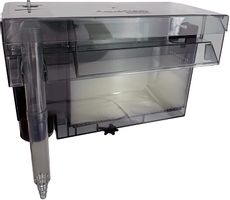
Most people are familiar with the hang on back (HOB) style filters. If you had a freshwater fish tank as a kid, this is likely the type of filter that it had. This style of filter sits on the top rim of your aquarium and sucks water through it, running it over some type of filter cartridge before shooting it back out into the tank. Most models also run the water over some type of "bio media" which is used to grow out your biological filtration.
The cartridges that these filters use are generally plastic cages with filter floss on the front water facing side and granular activated carbon inside. The filter floss acts as a mechanical filter, straining larger solids like food and fish waste out of the water. The carbon inside the cartridge acts as a chemical filter which, again, is likely not needed in a healthy tank.
These units tend to be relatively large since they have to contain the filter media itself, some type of bio media (bio balls and ceramic rings being the most common), and the pump to pull the water through the unit. They're generally mounted on the back of the aquarium, so you'll have to make sure that you have enough space between the tank itself and the wall behind it.
General maintenance on a hang-on-back filter will mostly just require you to replace the filter cartridges. You'll buy packs of them and, every week or two, just pop the old one out and stick the new one in.
This style of filter does definitely work in a saltwater tank, but it's not generally going to be the most effective approach. If you have a large tank, then a HOB filter is likely not a good candidate at all. Hang on back filters are generally best suited for smaller or entry-level tanks where you want to avoid any large upfront investments.
Benefits
- ✓ All in one, self-contained unit
- ✓ Cheap and easy for beginners
- ✓ Biological and mechanical
Drawbacks
- ✗ Unnecessary chemical layer
- ✗ Big and bulky visuals
- ✗ Geared for freshwater
Canister Filter
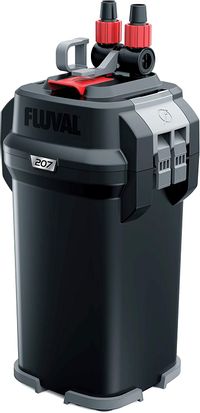
Canister Filters are similar to hang-on-back filters except they exist outside your aquarium - generally being hidden underneath it. A pump in the canister filter pumps water out of your tank and through the filter, returning it back into your tank through a separate tube. Depending on your setup, the canister filter may also pump the water into a sump rather than directly back into your tank.
Inside a canister filter there are generally multiple layers of filter media. Most hobbyists follow these general guidelines:
- Mechanical filtration - filter floss or a filter pad - is always going to be the first layer that the water hits in the canister filter. It removes solids like extra food and fish waste from the water.
- Chemical filtration layer - activated carbon - will oftentimes come next. In general, you don't need it, but it doesn't hurt to include it and will definitely help remove any odors.
- Finally, there should be ample room for biological filtration media. Bio Balls and pieces of ceramic are the most common. Once you put these in, you should essentially never replace them.
One drawback to a canister filter is that you do have to take it apart to replace your mechanical filtration. Over time, your water flow is going to be reduced due to build up within the canister itself. It's important to keep it clean so that your filter continues to operate at a high capacity.
Canister filters are great for small to medium-sized saltwater aquariums. When looking for one, pay particular attention to the number of gallons per hour that it can filter and shoot for 5-10x the gallons of water in your tank.
Benefits
- ✓ Multi-layer filtration
- ✓ Hidden from View
- ✓ High Media Capacity
Drawbacks
- ✗ Harder to Clean
- ✗ Nitrate Traps if ignored
- ✗ Flow rate slows with age
Protein Skimmer
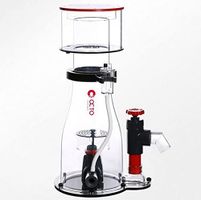
Protein skimmers are the heavy hitters of mechanical filtration. They use really small bubbles to separate organic matter (like food and fish waste) from the water before it can even begin to break down into ammonia.
The organic waste hitches a ride on the bubbles as they rise through a column, eventually forming a thick foam that spills over into a collection cup. You just have to empty and clean the cup every few days.
Benefits
- ✓ Highly effective
- ✓ Low maintenance
- ✓ Can be hidden in sump
Drawbacks
- ✗ Can be noisy
- ✗ Tuning required
- ✗ High upfront cost